


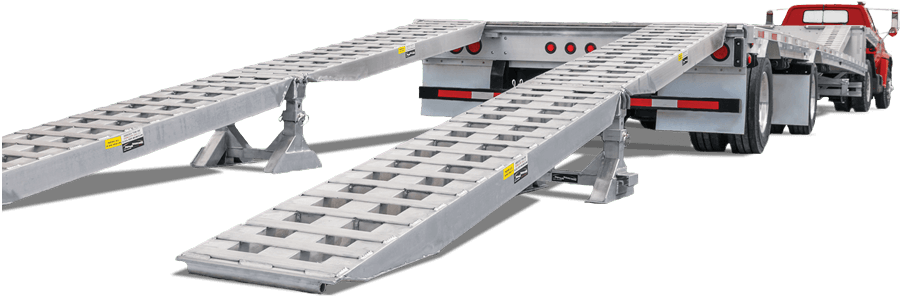
Heavy-Duty Ramps + Load levelers
At Verduyn Tarps, we're dedicated to enhancing your trucking experience. That's why we offer a top-quality selection of load levelers and heavy-duty truck ramps for sale. Our products are designed to simplify the loading and leveling of heavy-duty items so that your cargo is balanced and stable.
Filter Products
Showing 1–15 of 16 results
- Sale!

- Sale!


- Sale!





In the Canadian logistics landscape, heavy-duty ramps and load levelers are essential tools that keep freight moving safely and efficiently.
What are the key differences between heavy-duty ramps and load levelers?
Ramps are inclined platforms that allow vehicles, equipment, or cargo to move between different elevations, typically from ground level up to a trailer or flatbed. In trucking, they play a key role in helping operators maximize their deck space and access their deck safely and efficiently. Whether you’re loading heavy equipment, delivering in rural areas, or working on mobile or construction sites with limited infrastructure, ramps provide the flexibility and stability needed to keep operations moving smoothly.
Load levelers, also known as dock levelers, are devices that connect a loading dock to a truck bed, compensating for height differences. Unlike ramps, which create a slope, load levelers provide a flat or slightly inclined surface that allows forklifts and pallet jacks to move safely across uneven connections.
While ramps offer portability and flexibility, load levelers are built for high-volume, fixed-location operations like warehouses and distribution centers.
In Canada, where weather and terrain vary widely, choosing between the two often depends on site conditions, cargo type, and frequency of use.
Practical Uses for Ramps and Load Levelers
Ramps and load levelers play complementary roles in ensuring safe, efficient cargo movement across Canada’s diverse industries and terrains. Whether you're operating in a remote northern community or a busy urban distribution hub, these tools help bridge elevation gaps and streamline loading processes.
- Equipment loading in remote or rural areas. Portable ramps allow crews to load heavy machinery like generators, ATVs, or skid steers onto trailers without permanent infrastructure. A load leveler may be used at regional depots to assist with trailer transfers when dock height varies.
- Warehouse and distribution center operations. Load levelers are essential in high-volume facilities across cities like Toronto, Calgary, and Montreal, enabling forklifts and pallet jacks to move safely between the dock and trailer. Ramps serve as backup or supplementary access points when dock space is limited.
- Agricultural and seasonal workflows. Farmers use ramps to transfer seed, feed, and equipment during planting and harvest. Load levelers help maintain efficient trailer unloading during peak seasons, especially when dealing with bulk shipments.
- Construction and municipal services. Ramps support mobile crews loading compactors, excavators, and other gear onto flatbeds. Load levelers are used in public works to facilitate consistent loading of materials and supplies.
- Retail and event logistics. Ramps are ideal for mobile vendors and pop-up installations, allowing easy access to trucks and trailers. Load levelers support retail supply chains during seasonal inventory shifts, ensuring smooth transitions between delivery vehicles and receiving docks.
- Emergency and utility response. Fire departments, hydro crews, and mobile medical units use ramps for rapid deployment of gear. Load levelers in municipal facilities help manage incoming supplies and equipment during emergencies.
Key Features to Consider When Choosing Ramps and Load Levelers
- Weight Capacity
This matters because overloading can cause structural failure or injury. Choose a product rated for your heaviest equipment or cargo, with a safety buffer of 20-30%. Capacities are typically listed in kilograms and pounds. - Material and Build Quality
Steel ramps are durable and ideal for heavy-duty use. Aluminum is suitable for mobile setups because it is lightweight and corrosion-resistant. It is also important to ensure that the materials are compliant with Canadian Standards Association requirements. - Surface Traction
This prevents slips and accidents, especially in wet or icy conditions. Serrated steel grating, grooved surfaces, or rubberized coatings are some of your options to increase surface traction. - Adjustability and Compatibility.
Load levelers should accommodate varying trailer heights and dock configurations, while ramps should have adjustable legs or modular sections for uneven terrain. In Canada, flexibility is key in remote or multi-site operations. - Safety Features
You should consider ramps and load levelers that have skid seats or anchor points to prevent movement during use. Safety lips on load levelers might be necessary to prevent your cargo from rolling off the edges. For added protection when loading equipment, you should also consider ramps and load levelers with side rails. - Ease of Installation and Maintenance
Hydraulic systems offer smoother operation but may require more maintenance. Choosing between a portable and fixed should depend on whether your setup is mobile or permanent. - Storage and Portability
You can choose foldable and stackable designs to save space and simplify cleanup. Integrated handles or wheels are useful for mobile crews and temporary setups. Depending on your trailer type, installing ramp hangers can be beneficial to conserve space on your deck by allowing you to store your ramps underneath your trailer when not in use.
FAQs
1. How do I choose the right capacity?
Start with the heaviest equipment or cargo you expect to load. Add a 25-30% safety buffer. In Canada, capacities are typically listed in both kilograms and pounds. Make sure to check both.
2. Do I need skid seats?
Definitely! Especially if you are working on uneven, icy, or outdoor terrain. Skid seats help anchor the ramp securely and prevent shifting during use, which is critical for safety.
3. Can these ramps double as load levelers?
Not Safely. Ramps are designed for inclined access, while load levelers are built to bridge horizontal gaps at dock height. Using one as the other may compromise stability and violate CSA safety standards.
4. What improves traction and safety in bad weather?
Look for serrated steel, grooved surfaces, or rubberized coatings. In Canadian winters, anti-slip finishes and snow-rated designs are crucial for preventing slips and maintaining control.
5. How do I store everything cleanly?
Choose foldable or modular rams that stack easily. Wall-mounted brackets or vertical storage racks help keep your facility organized, especially during off-season or in tight urban yards.
6. Do you install the hardware?
Yes! We offer hardware installation services for ramps and load levelers. Let us know if you need anything- we are just a message away!
Our selection of loading ramps for sale, including heavy-duty ramps for trailers and versatile truck ramps, is designed to make your job more effortless and efficient, ultimately boosting profitability. Shop our range of load levelers, trailer levelers, and ramps truck accessories online today to find the perfect fit for your trucking needs in Canada.
Simply Contact us by clicking here or calling us at the number at the top of the screen.
